Urea vs Ammonium Nitrate: Which Nitrogen Fertilizer Is Right for You?
Let's just get into it.
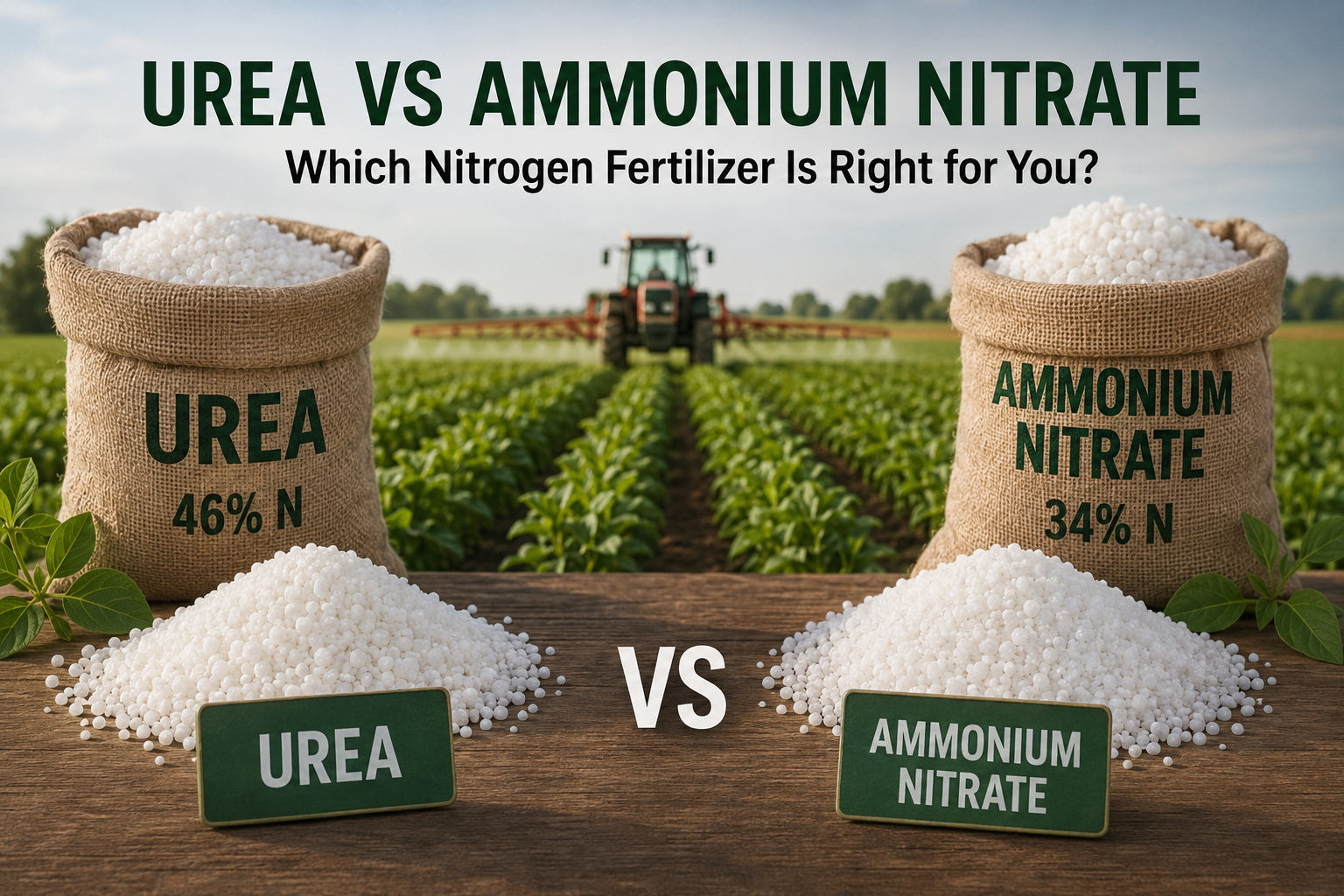
If you've spent any time managing crop nutrition, you've probably stood in a supplier's office or scrolled through prices online and wondered , urea or ammonium nitrate? Both supply nitrogen. Both are white-ish granules. Both end up doing the same job in the soil eventually. So why does it matter which one you pick?
It matters a lot, actually. And not just because of cost , though that's a big one. The way these two fertilizers behave after you apply them is fundamentally different. And if you're applying the wrong one at the wrong time in the wrong conditions, you could be throwing a significant chunk of your nitrogen investment into the air. Literally.
So let's talk through everything. The chemistry, the cost, the risks, the timing, the crops. By the end of this you'll know exactly which one to reach for in any situation.
First, the basics , what are we actually talking about?
Urea has the chemical formula CO(NH₂)₂. It's 46% nitrogen by weight, which makes it the most concentrated dry nitrogen fertilizer that exists on the market. That's not a small thing , higher concentration means lower transport costs, lower storage volume, lower handling per unit of nitrogen. When logistics matter (and they always matter), this is significant.
Ammonium Nitrate , let's call it AN from here , has the formula NH₄NO₃. It sits at 34% nitrogen. Still high compared to many other fertilizers, but noticeably lower than urea. The interesting thing about AN is that its nitrogen comes in two forms simultaneously: half ammonium (NH₄⁺) and half nitrate (NO₃⁻). That dual form is actually the whole reason AN behaves differently in the soil, and we'll get into exactly why that matters.
Both are manufactured industrially via the Haber-Bosch process, which turns atmospheric nitrogen into ammonia. Urea adds CO₂ to that ammonia. AN reacts the ammonia with nitric acid. So they start from the same place and diverge from there.
The nitrogen content gap , and what it really costs you
46% vs 34%. That's a 35% difference in nitrogen concentration. So on a per-kilogram basis, urea is delivering more nitrogen.
But here's where a lot of farmers get confused: they compare the bag price, not the cost per kilogram of nitrogen actually delivered. And those two numbers tell very different stories.
Let's say urea costs $400 per tonne and ammonium nitrate costs $380 per tonne (rough ballpark , your local prices will vary).
At those prices:
- Urea: $400 ÷ 460 kg of N per tonne = $0.87 per kg of N
- AN: $380 ÷ 340 kg of N per tonne = $1.12 per kg of N
Urea wins on paper. Cheaper per unit of nitrogen. But , and this is the part people underestimate , that calculation assumes you're actually capturing all the nitrogen in urea. Which, depending on your situation, you might not be.
This is where volatilization comes in.
Volatilization , the silent profit killer in urea applications
This is probably the single most important practical difference between the two fertilizers, and it doesn't get nearly enough attention.
When you apply urea to soil, it doesn't go straight into plant-available form. First, an enzyme called urease (which is present in almost every soil, produced by bacteria and fungi) breaks the urea down into ammonium carbonate. Then that ammonium carbonate decomposes and releases ammonia gas (NH₃) into the atmosphere.
That process , urea converting to ammonia gas and floating away , is called volatilization. And it can be catastrophic for your nitrogen efficiency.
How much nitrogen can you lose? Studies have shown losses anywhere from 10% to over 50% under the worst conditions. So if you're expecting 100 kg of N to go into your crop, you could actually be delivering 50–90 kg depending on when and how you apply it.
The conditions that accelerate volatilization:
- High soil pH , alkaline soils (pH above 7) dramatically speed up the urease reaction
- High temperature , warm soil and air temperatures speed everything up. Above 20°C starts getting risky, above 30°C is genuinely bad
- Surface application without incorporation , if urea just sits on top of dry soil with nothing to wash it in, urease breaks it down and the gas escapes upward
- High soil moisture at surface , a moist surface layer without rain to actually carry the urea downward is almost ideal for loss
- Crop residue on the surface , residue contains a lot of urease. Applying urea onto a wheat stubble field is asking for trouble
Ammonium nitrate doesn't have this problem. Because half its nitrogen is already in nitrate form (which doesn't volatilize) and the ammonium half converts through a different pathway, AN doesn't go through the urease-driven volatilization process. You apply it, it stays put. The nitrogen efficiency is more reliable.
This is a real, concrete reason why many commercial crop farmers in warm climates gravitate toward AN even when urea is nominally cheaper. Because the actual delivered nitrogen per dollar can flip once you account for losses.
So when does urea actually win?
Urea isn't a bad fertilizer , not even close. It's the world's most widely produced nitrogen fertilizer for good reason. It just needs to be used right.
When urea is the better choice:
1. When you can incorporate it immediately. Tillage or irrigation right after application is the most effective way to stop volatilization. The urea gets washed below the surface layer, away from the urease-rich zone, and the ammonia can't escape. In irrigated systems where you can apply and then immediately run water, urea's cost advantage holds up completely.
2. When it's cool. Below 10°C, urease activity slows dramatically. Applying urea in early spring in cooler climates, or at night in warmer climates, can reduce losses significantly. Not eliminate them , but reduce.
3. When rain is forecast within 24–48 hours. A good rain event after surface application will move the urea into the soil before too much gas escapes. Not ideal to gamble on weather forecasts, but if you're confident in the prediction, it's a workable strategy.
4. In flooded or waterlogged conditions. In paddy rice systems, urea is actually often preferred over AN because under flooded conditions, volatilization dynamics change and urea can be incorporated into the standing water. AN's nitrate component actually leaches or denitrifies more readily under flooded, anaerobic conditions , so the tables turn.
5. When you need high-volume applications and logistics cost is a real constraint. If you're managing thousands of hectares or transporting fertilizer long distances, the compact nature of urea (more nitrogen per tonne moved) is a genuine economic advantage.
When ammonium nitrate wins
AN's consistent performance in varied conditions makes it the safer bet for a lot of scenarios.
1. Surface applications without irrigation. If you're broadcasting onto a growing crop (top-dressing), AN is significantly more reliable. No volatilization risk. The nitrogen sits at the surface until rain, then moves down. Urea doing the same thing in warm weather could lose 20–30% before the rain arrives.
2. In high-pH soils. Alkaline soils are where urea loses the most nitrogen. AN doesn't have that sensitivity. If your soil pH is 7.5 or above, AN's efficiency advantage is real and significant.
3. When speed matters. The nitrate form in AN is immediately available for plant uptake without any conversion step. Plants take up nitrate directly. Urea has to go through urease conversion, then nitrification, before the nitrogen is in nitrate form. In a situation where the crop is nitrogen-stressed right now and you need a quick response, AN delivers faster. Especially noticeable in cold soils where nitrification of urea's ammonium form slows down.
4. Winter wheat top-dressing. This is probably the most well-established practical example. Applying nitrogen to winter wheat in late winter/early spring, before stem elongation, is standard practice. The conditions , cool temperatures, often no incorporation , seem like they'd suit urea too. But even in cool conditions, if a dry spell follows application, AN consistently outperforms urea on surface-applied top-dressings. Multiple European studies over decades have confirmed this.
5. When you want predictability. Maybe the most underrated reason. With AN, what you apply is approximately what you get. There's less variability. In farming, reducing variability is often worth paying a small premium for , because variable nitrogen delivery leads to variable yield, which makes everything harder to manage.
The safety issue with ammonium nitrate , let's address it directly
It would be dishonest to write about AN without talking about this.
Ammonium nitrate is an oxidizer. In its pure, concentrated, prilled form, it's been involved in some of the worst industrial accidents in history , Texas City in 1947, Beirut in 2020. And because of this, AN is subject to strict regulations in many countries. Some places have effectively banned high-concentration AN for agricultural use entirely, replacing it with calcium ammonium nitrate (CAN) , which is essentially AN diluted with calcium carbonate to bring the nitrogen content to around 26–28% and reduce the explosive potential.
For a farmer, this means a few practical things:
- Availability varies massively by country. In the UK, high-AN fertilizers are still available but regulated. In parts of the US, access is restricted. In some countries it's unavailable for purchase by private individuals.
- Storage requirements are stricter , proper buildings, away from fuel and organic materials, temperature monitored
- Transport regulations apply
Urea has none of these concerns. It's non-explosive, non-flammable in its standard form, and can be stored and transported without the regulatory headache.
If AN is restricted or unavailable in your region, or if the storage situation is complicated, urea plus good application management is the practical answer. Period.
Leaching , which one is more at risk?
Here's an aspect that often gets skipped over but matters a lot in high-rainfall regions or sandy soils.
Nitrate (NO₃⁻) is negatively charged. Soil particles are also negatively charged. So they repel each other , nitrate doesn't stick to soil particles and moves freely with water through the soil profile. This means nitrate leaches.
Ammonium (NH₄⁺) is positively charged. It gets attracted to negatively charged soil particles (clay, organic matter) and is held in the soil. It doesn't leach easily.
Now think about what this means for our two fertilizers.
Urea, after conversion, ends up as ammonium before being further converted to nitrate through nitrification. So in the early period after application, its nitrogen is mostly in ammonium form , held in the soil, not leaching.
AN immediately provides half its nitrogen as nitrate , the leachable form. In a heavy rain event shortly after AN application, that nitrate fraction is vulnerable to movement below the root zone.
So on sandy soils with high rainfall, the nitrogen efficiency calculation can flip again , urea's ammonium form might actually be more efficient than AN in those conditions.
On the other hand, in waterlogged/flooded conditions or compacted soils with poor aeration, the ammonium from urea can be lost through denitrification (conversion to nitrogen gas under anaerobic conditions). So AN isn't universally safer from leaching either.
The honest answer is: both have leaching vulnerabilities, just in different conditions and for different fractions of their nitrogen. The key is matching the fertilizer to the drainage characteristics of your specific field.
Soil acidification , a longer-term consideration
Both fertilizers acidify soil over time. This is true of basically all ammonium-containing nitrogen fertilizers.
The process goes like this: ammonium in the soil gets converted to nitrate by nitrifying bacteria (a process called nitrification). This releases hydrogen ions (H⁺), which lower soil pH. The more nitrogen you apply over years and decades, the more acidification accumulates.
Urea has slightly higher acidifying potential than AN on a per-unit-of-nitrogen basis, partly because 100% of urea's nitrogen passes through the ammonium-nitrate conversion pathway, while AN's nitrate half skips that step. But in practice, the difference is marginal and manageable with regular liming.
If soil pH is already on the lower end (below 6), this is worth factoring in , but it's not usually the deciding factor between the two fertilizers. It's just a reminder that regular soil testing and lime applications are part of any nitrogen fertilizer program regardless of which product you choose.
Urease inhibitors , a game changer for urea?
There's an important category of products worth mentioning: urease inhibitors, particularly NBPT (N-(n-butyl) thiophosphoric triamide), sold under brand names like Agrotain.
Urease inhibitors slow down the urease enzyme. This gives urea more time to move into the soil before it converts to ammonium at the surface and risks volatilization. Applied as a coating on urea granules, they can reduce volatilization losses by 50–80% in trials.
So urea + NBPT is a genuinely different proposition from bare urea. In many surface-applied situations where AN would normally be the more efficient choice, treated urea can close a lot , or all , of that efficiency gap.
The tradeoff is cost. NBPT-treated urea costs more per tonne than bare urea. Whether it pencils out depends on:
- The expected volatilization loss if you used bare urea (higher expected loss = bigger benefit from treatment)
- The price difference between treated urea and AN in your market
- Your application conditions (hot, alkaline, no rain forecast = big benefit from inhibitor)
In many warm-climate, dryland farming situations, treated urea is now considered the default rather than AN. It's worth getting quotes for both and running the numbers.
Crop-by-crop breakdown
Different crops in different systems interact differently with these two fertilizers. Let me go through the major ones.
Wheat (and other small grains)
Wheat is probably the crop where this comparison matters most, because the main nitrogen application , spring top-dressing , is usually a surface broadcast without incorporation.
For dryland wheat top-dressing, AN (or CAN) has historically been the preferred choice in most studies and in practical farming experience. The surface application risk with urea is real. If you're using bare urea, incorporate it or time it with rain very carefully.
If you're in a country where AN is restricted or expensive, NBPT-treated urea is the next best option for dryland wheat top-dressing.
For pre-sowing or drilling applications where the fertilizer gets soil coverage, urea's efficiency improves considerably and the cost advantage comes back.
Maize / Corn
Maize is typically a spring/summer crop in warm conditions. Urea's volatilization risk is highest here. But maize also allows more flexibility in application method , side-dressing, injection, fertigation , which can mitigate urea losses significantly.
Injected urea or urea-ammonium nitrate solution (UAN) into soil is extremely efficient because the nitrogen goes below the surface immediately.
For surface-broadcast maize applications in warm weather: AN or treated urea. For injected or fertigated systems: urea solution works well.
Rice (paddy)
Paddy rice is the case where the usual rules get inverted. In flooded conditions, nitrate leaches rapidly and can also denitrify under the anaerobic conditions in the saturated soil. Urea is generally preferred for paddy rice , often broadcast into standing water where it dissolves and distributes, and the flooded conditions slow some loss pathways.
That said, timing in paddy rice matters enormously too , applications at the right growth stage (tillering, panicle initiation) with good water management can make both fertilizers work.
Vegetables and high-value crops
For intensively managed vegetables , especially those with fertigation systems , urea solution (often mixed in irrigation water) is extremely common and works very well. You can deliver precise nitrogen doses, the system is efficient, and the cost per unit of N is low.
AN in fertigation is also used but urea is generally more soluble and easier to handle in solution systems.
For broadcast vegetable applications, the same rules as other crops apply , surface + warm + no rain = prefer AN or treated urea.
Pasture
Pasture nitrogen applications are usually surface broadcasts with no incorporation. And pastures in many regions are grazed, which means you can't just say "wait for rain" , you need predictable nitrogen response timing for your grazing rotation.
AN has historically dominated pasture applications in countries where it's available. The efficiency predictability matters. In countries where AN is restricted, NBPT urea has become the practical alternative.
Storage and handling , the day-to-day practicalities
This part rarely makes it into agronomic articles but it absolutely matters on a real farm.
Urea storage is relatively straightforward. It's hygroscopic , meaning it absorbs moisture from the air , so it needs to be kept dry. Damp storage leads to caking, which makes spreading difficult and uneven. But beyond keeping it dry, there's not much to worry about. No fire risk, no explosion risk, no special permits. You can keep it in a regular dry shed. Small bags stack fine, bulk storage in a covered bin works well.
One thing worth knowing: urea can react with certain materials , some plastics and metals , particularly in liquid form. If you're dissolving it for foliar or fertigation use, check your equipment compatibility. But for standard granular storage, it's uncomplicated.
Ammonium nitrate storage is a different matter entirely. Depending on concentration and your local regulations, you may need:
- A dedicated, ventilated storage building
- Fire suppression systems
- Separation from fuels, oils, and organic materials
- Temperature monitoring in some jurisdictions
- Security measures , locked, limited access
- Record-keeping and sometimes notification to authorities above certain stored quantities
The higher the AN concentration (high-N AN at 33–34% is more regulated than CAN at 26–27%), the stricter the requirements generally are.
This isn't to scare you off AN , farmers have stored and used it safely for decades. But if you're a smaller operation without existing compliant storage, or if you're in a region with strict regulations, the infrastructure cost of doing AN properly can genuinely tip the economic decision toward urea.
Spreading characteristics , both are granular dry products and spread reasonably well through most broadcast spreaders. Urea granules are typically rounder and more uniform, which gives good spreading spread patterns. Prilled urea is smaller and lighter than granular, so calibrate your spreader accordingly. AN is slightly denser and spreads well but can vary by product form (prilled vs granular). Both are affected by wind , apply on calm days when possible.
In wet conditions , urea absorbs moisture faster and can clump in the spreader hopper during damp weather. AN is slightly more robust in marginal conditions. Not a major issue, but something to know if you're spreading in changeable weather.
Application rates , how to actually calculate what you need
A lot of guides stop at "urea is 46-0-0 and AN is 34-0-0" without helping you actually figure out how much to apply. Let's do that.
Say you want to apply 100 kg of nitrogen per hectare.
Using urea (46% N): Amount needed = 100 ÷ 0.46 = 217 kg of urea per hectare
But if you expect 20% volatilization loss under your application conditions: You actually need to deliver 100 kg N to the crop, so account for the loss: Effective dose = 100 ÷ 0.80 = 125 kg N worth of urea Amount applied = 125 ÷ 0.46 = 272 kg of urea per hectare
Using ammonium nitrate (34% N): Amount needed = 100 ÷ 0.34 = 294 kg of AN per hectare
With minimal surface losses (say 5%): Effective dose = 100 ÷ 0.95 = 105 kg N Amount applied = 105 ÷ 0.34 = 309 kg of AN per hectare
Now do the cost comparison at local prices. Multiply kg per hectare by price per kg to get cost per hectare for each option. That's the number that actually matters.
Most farmers don't do this calculation explicitly , they just apply recommended rates from a label or an agronomist's advice. But understanding the logic means you can adapt when conditions change, when prices shift, or when you're trying to figure out why your expected yield response didn't materialise.
If you want this done automatically, the FertiCalc calculator does exactly this , enter your target N%, your field volume (or area if you work out the application volume per hectare), select your fertilizer, and it outputs the exact amount needed. Takes thirty seconds.
The nitrification timeline , understanding what happens in the soil week by week
This is slightly more technical but genuinely useful if you're trying to synchronise nitrogen availability with crop demand.
After you apply urea:
- Days 1–3: Urease converts urea to ammonium carbonate. Speed depends heavily on temperature and urease activity. In warm soil (>20°C), this can complete in 1–2 days. In cold soil (<10°C), it might take 1–2 weeks.
- Days 3–10+: Ammonium is held by soil particles. Some is taken up directly by plants as NH₄⁺. The rest begins converting to nitrate via nitrification (Nitrosomonas and Nitrobacter bacteria). Again, temperature-dependent.
- Weeks 2–4: Most of the nitrogen is now in nitrate form, mobile and available. Peak nitrate availability for plant uptake.
After you apply AN:
- Immediately: Nitrate fraction (half the N) is dissolved and immediately available for uptake. No conversion needed.
- Days 1–7: Ammonium fraction (other half) follows the same nitrification pathway as urea , slowly converting to nitrate.
- Weeks 1–3: All nitrogen is in nitrate form and available.
So AN gives you an immediate nitrate hit followed by a slower ammonium release. Urea gives you a slightly delayed but then steady release once the urease conversion completes.
For crops with urgent nitrogen needs , visible deficiency symptoms, pale leaves, stunted growth , AN's immediate nitrate fraction gives a faster visual response. You might see greening within days of AN application. Urea takes a bit longer for the visible response, even if total nitrogen delivery over the season is similar.
For pre-planned applications where you're building up the nitrogen bank before peak demand, the delay with urea is less relevant.
Environmental considerations , beyond just your crop
Nitrogen loss isn't just a financial issue. It's an environmental one.
Ammonia volatilization from urea contributes to atmospheric nitrogen deposition , which affects ecosystems, contributes to particulate matter (ammonia reacts with acids to form fine particles), and is increasingly regulated in some regions under air quality legislation.
Nitrate leaching from both fertilizers (but particularly from AN's immediate nitrate fraction) contributes to groundwater contamination and eutrophication of water bodies.
Denitrification from both fertilizers under anaerobic conditions produces nitrous oxide (N₂O), a potent greenhouse gas , roughly 300 times more powerful than CO₂ over a 100-year horizon.
None of this means you shouldn't use nitrogen fertilizers. Global food production depends on them. But it does mean that efficient application , right product, right rate, right time, right place , matters beyond just your farm economics. Reducing losses is both profitable and the right thing to do.
The practical decision tree
When you're standing there deciding which one to buy, run through this:
Is the application going to be incorporated (tilled in, injected, or irrigated in immediately after)? → Yes: Urea. Cost advantage holds up, volatilization avoided. → No: Go to next question.
Is soil temperature above 15°C at the time of application? → Yes: Lean toward AN or treated urea. Volatilization risk from bare urea is meaningful. → No (cool conditions): Urea is more acceptable, but still watch soil pH and surface conditions.
Is soil pH above 7.5? → Yes: AN is significantly better. Urea loses a lot in alkaline soils. → No: Either can work with appropriate precautions.
Is the crop a flooded paddy rice system? → Yes: Lean toward urea , AN's nitrate fraction is vulnerable under flooded conditions. → No: Continue.
Is rain forecast within 24–48 hours with reasonable confidence? → Yes: Urea is workable, just apply and let the rain do the incorporation. → No: AN or treated urea is safer if surface-applying without incorporation.
Is AN subject to restrictions or simply unavailable in your region? → Yes: Use NBPT-treated urea for surface applications. Bare urea with incorporation for pre-sow/drilling. → No: Make the cost comparison on per-unit-N basis and decide from there.
Running the real cost comparison
Before you buy, do this calculation properly.
Get quotes for both products. Then:
Cost per kg of N:
- Urea: (price per tonne ÷ 460) = cost per kg N
- AN: (price per tonne ÷ 340) = cost per kg N
- CAN (27% N): (price per tonne ÷ 270) = cost per kg N
Then adjust for expected efficiency losses if applying without incorporation in warm conditions:
- Bare urea, surface, warm, alkaline: assume 15–35% loss → multiply cost per kg N by 1.2–1.5 to get real cost
- NBPT urea, surface, warm: assume 5–15% loss
- AN, surface: assume 2–8% loss (leaching risk varies by soil/rainfall)
That adjusted cost per kg of N delivered to the crop is what actually matters.
In many markets and conditions, once you run those numbers, the gap between the two narrows considerably. Sometimes AN comes out cheaper on a delivered-N basis despite the higher sticker price per tonne. Sometimes urea still wins. It depends on your local prices and your specific application conditions.
What the research actually says , a quick look at the data
I want to ground this in something real, because a lot of fertilizer advice floats around without much evidence behind it.
There have been hundreds of field trials comparing urea and AN across different crops, climates, and application conditions. The conclusions are pretty consistent:
In incorporated or irrigated applications, urea and AN perform essentially identically in terms of crop yield and nitrogen use efficiency. Multiple meta-analyses across wheat, maize, and other cereals find no statistically significant difference in yield when urea is properly incorporated. The cost advantage of urea in these situations is real.
In surface-applied situations without incorporation, AN consistently outperforms urea in warm and dry conditions. The yield gap varies from negligible in cool/wet conditions to 10–20% in hot and dry ones. This is the most important finding practically, because surface top-dressing is how a huge proportion of in-season nitrogen gets applied.
With NBPT inhibitor, treated urea closes most of the gap in surface applications. Trials consistently show NBPT urea performing close to AN in volatilization-prone conditions , usually within 3–7% yield difference, sometimes statistically equal.
In alkaline soils, the advantage of AN is most pronounced. Studies on soils with pH above 7.5 show urea losses severe enough to make AN clearly superior even at a higher cost per tonne.
The research isn't ambiguous on these points. The nuance is just that the answer depends on which scenario you're in , which is exactly the point of this whole comparison.
A note on UAN , the third option worth mentioning
Urea-Ammonium Nitrate solution (UAN) doesn't get as much attention as the two dry products, but it's worth knowing about.
UAN is typically 28–32% N, a liquid that contains both urea and ammonium nitrate dissolved together. It combines properties of both: some immediate nitrate availability, some slower-release urea fraction, and intermediate volatilization risk compared to surface-applied dry urea.
For farms with liquid application equipment, UAN is genuinely good , you can band it, inject it, apply it through irrigation systems, or use it for foliar applications (with appropriate dilution). The flexibility is real.
If you're investing in equipment anyway, UAN is worth pricing. In some regions it's very competitively priced. In others it's expensive because liquid transport and handling costs are higher.
Summary , which one should you use?
If someone forces me to give a single recommendation: for most farmers doing surface applications without immediate incorporation in warm conditions, ammonium nitrate (or CAN where AN isn't available) is the safer, more reliable choice. The predictability is worth it.
But urea is not the inferior fertilizer. It's cheaper per unit of N, widely available globally, easier to handle and store, and perfectly efficient when applied with incorporation or in systems where volatilization is managed. If you have an irrigated system, use urea. If you're in a cool climate, use urea carefully. If you're growing paddy rice, use urea. If transport and logistics are a major cost driver, urea.
And if you're in a region where AN is restricted, NBPT-treated urea is the practical answer for surface applications , the efficiency improvement is well worth the small premium.
The mistake is treating this as a permanent loyalty decision rather than a context-dependent one. The best farmers I know use both, switching based on the crop stage, the season, and the application method. That flexibility, knowing why each product behaves the way it does, is worth more than any blanket rule.
Talk to your agronomist, run your soil tests, check your local prices, and then decide with actual numbers rather than habit. Habit is expensive in farming. The farmer who bought urea every year because that's what his father bought, without ever checking whether AN or treated urea would recover the efficiency losses in his warm alkaline soil , he's been leaving real money in the air for years. Literally.
Don't be that farmer.
One last thing
And honestly, even if you've read every word of this and feel confident in your decision , double-check your rates. Wrong application rate is a bigger problem than wrong product choice in a lot of cases. Over-applying nitrogen is expensive and environmentally damaging. Under-applying leaves yield on the table. Getting the rate right matters just as much as getting the product right.
If you want to stop guessing at rates and actually calculate exactly how much of either fertilizer you need for your target nitrogen level, that's exactly what the FertiCalc calculator is built for. Plug in your target N%, your application volume, select urea or AN (or any of the other 50+ fertilizers in the database), and it gives you the exact grams or ml to use.
No spreadsheets. No manual formula. Just the number you need.
Related Agriculture Guides
- What is NPK? - The fundamental science of Nitrogen, Phosphorus, and Potassium.
- Fertilizer Compatibility - Why you should never mix Calcium Nitrate with Sulfates.
- Foliar Spray Guide - Safe application rates for Urea and other nitrogen sources.
- PPM to Grams Conversion - Master the math of precision nutrient delivery.