Beginner's Guide to Fertilizer Mixing for Hydroponics and Soil
Here's the honest truth nobody tells you when you're starting out: most beginner plant problems aren't about watering schedules or lighting or the wrong seed variety. They're about nutrition. Specifically, about fertilizer mixing done wrong, or not done at all, or done with the wrong product for the wrong system.
And it's not your fault. The fertilizer aisle, or the online fertilizer rabbit hole, is genuinely confusing. You've got powders, liquids, granules, organics, synthetic blends, NPK numbers that mean nothing until someone explains them, and product names that sound more like pharmaceutical drugs than plant food.
So let's fix that. This guide is written for beginners, people who are just getting into growing whether in soil at home, in raised beds, or in a hydroponic setup. No assumed knowledge. No skipping the basics. By the end you'll know what you're looking at when you pick up a fertilizer bag, how to mix it properly, and why the system you're growing in completely changes what you need.
Let's go.
Why fertilizer mixing matters more than people think
Plants need nutrients to grow. That's the starting point. And while soil does contain some natural nutrients, the reality is that most growing situations, especially intensive ones, eventually run out of what the plant needs. You either replenish it, or the plant tells you about it through yellowing leaves, slow growth, poor flowering, and weak roots.
Fertilizer is how you replenish it. But here's where beginners go wrong: they assume more is better, or they grab whatever's on sale without checking whether it suits their system, or they mix two products that have no business being combined and then wonder why their plants are struggling.
Getting fertilizer mixing right isn't complicated once you understand the logic. But that logic matters. You can't just throw powders into water and hope for the best. Well, you can. But you'll waste money and potentially damage your plants in the process.
So let's build the understanding first, then get into the practical mixing part.
The NPK fertilizer label, decoded once and for all
Every fertilizer bag or bottle you'll ever pick up has three numbers on it. Something like 20-10-10, or 10-52-10, or 3-1-2. These numbers are the NPK fertilizer ratio, and they represent:
N, which is nitrogen. The first number. Nitrogen drives leaf and stem growth. Plants that are nitrogen-deficient look pale, yellow-green, and generally sad. Too much, and you get a lush green plant that won't flower or fruit properly because it's too busy growing leaves.
P, which is phosphorus, expressed as P2O5 on most commercial labels. The middle number. Phosphorus is about roots, flowering, and fruiting. Seedlings love it. Flowering plants need it. If you're seeing poor root development or reluctant flowering in an otherwise healthy plant, phosphorus is usually worth looking at.
K, which is potassium, expressed as K2O. The third number. Potassium is the one that ties everything together, regulating water use, strengthening cell walls, improving disease resistance, and helping with the overall quality of fruits and vegetables. It's the nutrient that makes produce taste good, honestly.
So a fertilizer labelled 20-10-10 is 20% nitrogen, 10% phosphorus (as P2O5), and 10% potassium (as K2O). The rest of the weight is filler, binders, or other trace components depending on the product.
Understanding this is the foundation. Because once you know what these numbers mean, you can look at your plant, figure out what it needs, and choose the right NPK fertilizer accordingly. Young seedlings generally want higher P for root development. Leafy greens want higher N. Fruiting plants in their late stage want lower N and higher P and K.
The ratio matters. The form it comes in matters too. Which leads us to the first major split you need to understand.
Water soluble fertilizer vs granular vs liquid, what's the difference and why should you care
This is where a lot of beginners get tripped up. They buy a granular slow-release fertilizer and try to use it in their hydroponic system. Or they buy a liquid fertilizer meant for foliar feeding and try to use it as their main nutrient solution. Things don't go well.
Let's clear it up.
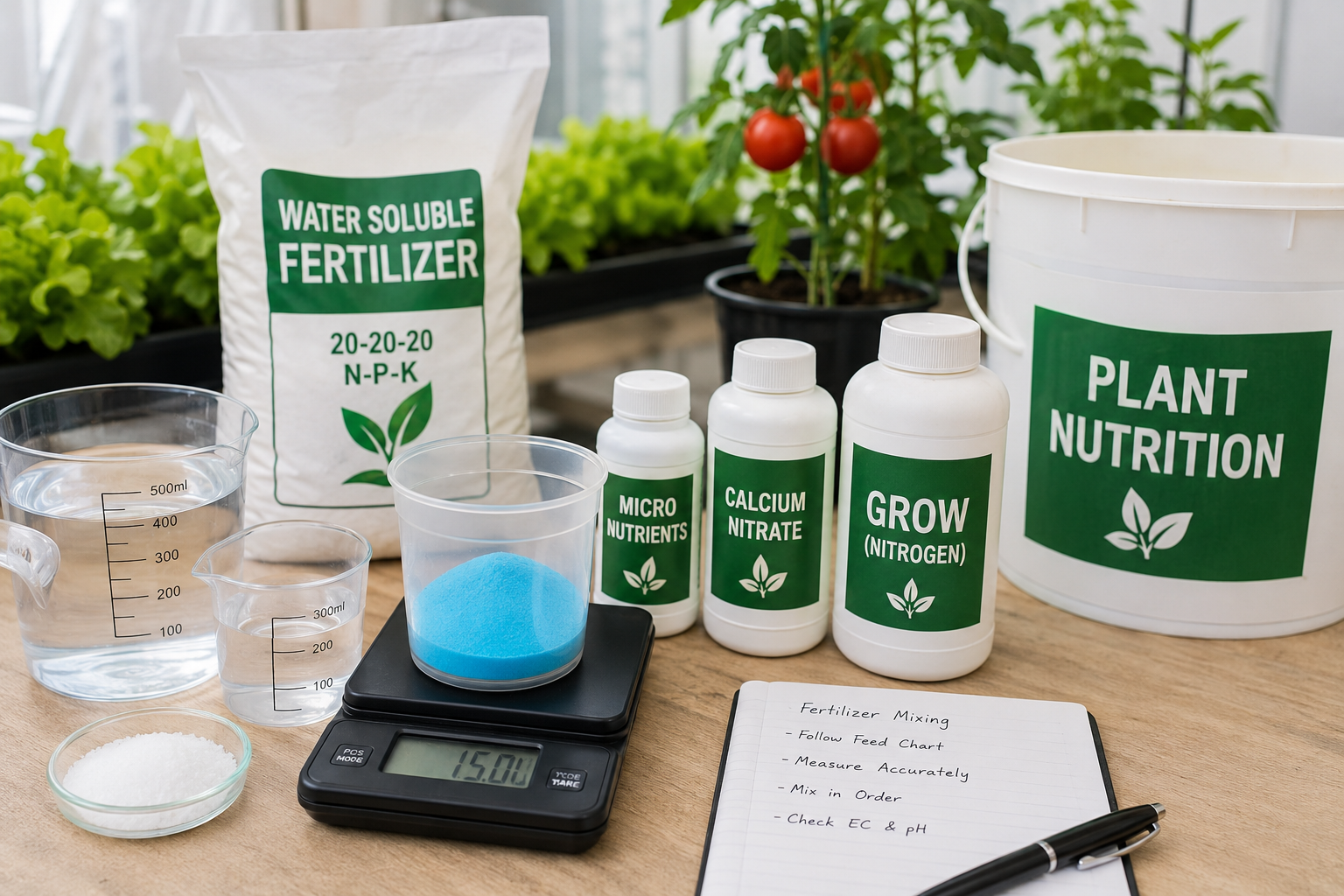
Water soluble fertilizer is exactly what it sounds like. It comes as a powder or crystal that dissolves completely in water, leaving a clear nutrient solution with no sediment. This is what hydroponic systems need. Full stop. If it doesn't dissolve completely, it can't circulate through your system properly, it clogs drippers and pipes, and it doesn't reach plant roots in a form they can use. Water soluble fertilizer for hydroponics is not optional, it's the only type that works properly.
Good water soluble fertilizers dissolve quickly, leave no residue, and have predictable nutrient content. Popular ones include mono potassium phosphate (MKP), potassium nitrate, calcium nitrate, and complete hydroponic nutrient blends from specialist brands. They tend to cost more than granular fertilizers on a per-kilo basis, but you use them in very small quantities because they're highly concentrated and fully available to plants.
Granular fertilizer is what most people picture when they think of soil fertilizer. Pellets or prill or small granules that you broadcast onto soil or work into the growing medium. Some are fast-release, breaking down quickly when they contact moisture. Others are slow-release or controlled-release, coated to dissolve gradually over weeks or months.
Granular NPK fertilizer for soil works because soil biology and chemistry do the work of breaking it down and making it available to roots over time. The soil acts as a buffer. In hydroponics, there's no buffer. Roots are directly in the solution, so you need instant, complete availability. Granular products can't provide that.
Liquid fertilizer is already dissolved in water, usually at a concentrated ratio. You dilute it before use, typically at ratios like 5ml per litre or 10ml per litre depending on the product. Liquid fertilizer is convenient, easy to measure, and fast-acting because there's no dissolution step. It's popular for both soil and hydroponic use, though the specific product formulation still matters for hydroponics.
The tradeoff with liquid fertilizer is that it's heavier and more expensive to transport and store than powder. For small home operations, the convenience is often worth it. For larger scale, powder usually makes more economic sense.
Organic fertilizer and why it's a different conversation entirely
Let's talk about organic fertilizer because it gets lumped in with everything else and it really shouldn't be.
Organic fertilizer comes from natural sources. Composted manure, bone meal, blood meal, fish emulsion, seaweed extract, worm castings, feather meal. The nutrients in organic fertilizer are tied up in complex organic molecules that need to be broken down by soil microorganisms before plants can access them. This is called mineralisation.
This is both the strength and the limitation of organic fertilizer.
The strength: it feeds the soil ecosystem, not just the plant. You're building microbial populations, improving soil structure, adding carbon, and creating a slow-release nutrient bank that keeps giving over time. Organic soil fertilizer used consistently over seasons builds soil health that makes growing progressively easier. That matters a lot.
The limitation: it's slow. The nutrients aren't immediately available. And the release rate depends on soil temperature, moisture, and biology, all of which vary. If a plant is deficient right now and needs nitrogen right now, organic fertilizer won't fix that in time. Synthetic fertilizer will.
The bigger limitation for hydroponics: organic fertilizer and hydroponic systems are a very uneasy combination. Most organic fertilizers don't fully dissolve. Particulates clog filters, pumps, and drippers. Decomposing organic material in a reservoir creates bacterial and fungal growth that throws the whole system off. There are specially processed organic hydroponic fertilizers available, fully soluble versions of fish hydrolysate and the like, but they're expensive, harder to find, and genuinely less predictable than synthetic hydroponic nutrients.
Most experienced hydroponic growers use synthetic nutrients. Full stop. If you want organic, grow in soil. That's not a compromise, soil growing with good organic fertilizer management produces excellent results. They're just different systems designed for different approaches.
What makes hydroponic fertilizer different from regular fertilizer
This needs its own section because it's not just about solubility.
In soil, certain nutrients come from the soil itself, not from what you add. Calcium, magnesium, iron, and various trace elements are often naturally present at usable levels in garden soil and potting mixes. You might add an NPK fertilizer and the soil fills in the gaps on other nutrients.
In a hydroponic system, there is no soil. The growing medium, whether that's rockwool, clay pebbles, coco coir, or perlite, contributes almost nothing nutritionally. Everything the plant needs has to come from the nutrient solution you mix. Everything.
So a complete hydroponic fertilizer needs to supply not just N, P, and K, but also calcium, magnesium, sulfur, iron, manganese, zinc, boron, copper, and molybdenum. These are the secondary and micronutrients that plants need in smaller quantities but absolutely cannot do without.
A standard NPK fertilizer designed for soil use won't have all of these. It doesn't need to, because the soil covers the rest. But if you use a basic soil NPK fertilizer in hydroponics, you'll grow plants that look okay for a few weeks and then start showing increasingly weird deficiencies as one micronutrient after another runs out.
This is why purpose-formulated hydroponic fertilizer exists. It's a complete nutrient package in a water soluble, fully available form.
Some systems use a single complete nutrient product. Others use a multi-part system, usually two or three separate bottles or powders that you mix in sequence, because certain nutrients (notably calcium and sulfate) precipitate out of solution and become unavailable if they're in the same concentrated bottle. That's why you'll see Part A and Part B systems, which you dilute separately before combining in your reservoir.
Always add concentrated nutrients to water, never add water to concentrated nutrients, and never mix Part A and Part B together in their concentrated form. This causes precipitation, white cloudy buildup in your reservoir, which means those nutrients are no longer available to your plants.
How to mix fertilizer for soil, the practical part
Right. Let's get into the actual mixing.
For soil growing, the process depends on whether you're using granular or liquid fertilizer.
Granular soil fertilizer is typically worked into the soil before planting, or top-dressed around established plants and watered in. The basic process:
Decide your application rate based on the product instructions and your soil test results if you have them. Most granular fertilizers give a recommendation in grams per square metre or kilograms per hectare. For home gardeners, it's usually something like 30-50g per square metre.
Broadcast the granules evenly over the soil surface, or work them into the top 10-15cm if you're preparing a bed. Water in thoroughly. This dissolves the granule surface and starts the nutrient release.
For slow-release granular fertilizers, one application can feed plants for 3-6 months depending on the product. Controlled-release coated granules are designed to release nutrients in response to soil moisture and temperature, which means they self-regulate to some extent.
For fast-release granular products, the nutrients are available quickly but also move through the soil quickly. More frequent, lower-dose applications generally work better than one large dose, which risks nutrient burn or leaching.
Liquid fertilizer for soil is even more straightforward. You dilute it in water, typically using a measuring jug or syringe for accuracy, and apply it to the soil around the plant base, or through a drip system.
The process: measure the concentrate carefully (eyeballing it leads to over or under application), add it to your water volume, stir briefly, apply. Most liquid fertilizers for soil use are applied every 1-2 weeks during the growing season.
One thing beginners get wrong is using full-strength concentrate directly on soil or worse, directly on roots. Concentrated liquid fertilizer is genuinely corrosive to roots. Always dilute first. Always water.
How to mix fertilizer for hydroponics, step by step
This is where precision really starts to matter. Hydroponic plants have no soil buffer. The nutrient solution is their entire world. Get it wrong and you feel it quickly.
Here's a clean process for mixing a hydroponic nutrient solution from powder or from a multi-part liquid concentrate.
Step 1: Start with clean water.
Water quality matters in hydroponics more than most beginners expect. Hard tap water with high calcium and magnesium content changes the nutrient balance. Very chlorinated water can affect beneficial bacteria in systems that use bioponics. If you're serious about it, get a basic TDS (total dissolved solids) meter and know what your tap water is starting with. Reverse osmosis water gives you a blank slate, but it's more expensive.
For most beginners using purpose-formulated hydroponic nutrients, tap water is fine. Just let it sit overnight to off-gas chlorine if you're concerned.
Step 2: Fill your reservoir or mixing container to the desired volume.
Always mix in the full final volume of water, not a small amount that you then top up. The concentration calculations assume a specific volume.
Step 3: Add nutrients in the correct order.
If you're using a Part A / Part B system, add Part A first. Mix well. Then add Part B. Mix again. Never add them together simultaneously in concentrated form. Some systems also have a Part C for certain trace elements, same principle, add in sequence with mixing between each.
If you're using a single powder water soluble fertilizer, add it to your water and stir until fully dissolved. Some powders take a minute or two to fully dissolve, especially in cooler water. Don't rush this.
Step 4: Check and adjust EC.
EC stands for electrical conductivity. It measures the total dissolved nutrients in your solution. A higher EC means more nutrients dissolved. Most hydroponic crops want an EC somewhere between 1.5 and 3.0 mS/cm, but this varies by crop and growth stage. Seedlings want lower EC (0.8-1.2). Mature fruiting plants want higher EC (2.0-3.0). Get a cheap EC meter, they're maybe £10-15, and actually use it. This is one of the most useful tools for beginner hydroponic growers.
If your EC is too low, you've under-dosed the nutrients. Add more and recheck. If it's too high, dilute with plain water.
Step 5: Check and adjust pH.
This is the other critical measurement. pH affects nutrient availability dramatically. Even if you've added the right nutrients in the right quantities, if pH is off, plants can't absorb them. In hydroponics, keep pH between 5.5 and 6.5 for most crops. 5.8-6.2 is the sweet spot that keeps all nutrients in their most available form.
Use a pH meter (not strips, they're not accurate enough) and pH Up (potassium hydroxide solution) or pH Down (phosphoric or citric acid solution) to adjust. Add in small drops, mix thoroughly, and recheck. pH adjustment is always slow and careful, not a big splash of pH Down and hope.
Step 6: Check temperature.
Nutrient solution temperature affects both oxygen content and nutrient uptake. Roots want cool, oxygenated solution, ideally around 18-22°C. Warmer water holds less oxygen. Above 24°C, root zone oxygen levels drop enough to stress plants and encourage pathogen growth.
This isn't a fertilizer mixing issue exactly, but it's part of getting your nutrient solution right. Especially in summer.
Common mistakes beginners make when mixing fertilizer
Let's go through the ones that actually happen regularly, not the obvious stuff.
Measuring by eye. Seriously, just buy a cheap digital kitchen scale. Powder fertilizers need to be weighed, not scooped by the handful. The difference between 5g and 10g of a water soluble fertilizer per litre is the difference between healthy growth and burned roots. Spend £8 on a scale.
Mixing incompatible nutrients together in concentrate. Calcium and phosphate do not belong in the same concentrated solution. They form an insoluble calcium phosphate precipitate immediately. This is why commercial hydroponic nutrients are formulated in separate parts. If you're making your own nutrient mix from individual salts (which is more advanced but very cost-effective), learn which nutrients precipitate with which, and keep them separate until they're diluted.
Using soil fertilizer in a hydroponic system. Covered this earlier but it's worth repeating because people do it anyway, usually because they have soil fertilizer at home and want to save money. Granular soil fertilizer in a hydroponic reservoir is a bad idea. Undissolved particles wreck pumps, incomplete nutrient profiles cause deficiencies, and organic material in the reservoir is a recipe for disease. Use the right product for the right system.
Applying organic liquid fertilizer as a main hydroponic nutrient. Fish emulsion is great for soil. It smells terrible and creates a bacterial swamp in a hydroponic reservoir. Some organic liquid fertilizers can be used as a supplement to synthetic nutrients in soil or even in hydroponics in small quantities, but not as a standalone nutrient solution replacement.
Changing nutrient concentration drastically between feeds. Plants adapt to a specific EC range. Swinging from low to high concentration between waterings stresses roots. Consistency matters more than hitting an exact target. A slightly lower EC applied consistently beats perfect EC applied erratically.
Ignoring the flush. In hydroponics, salt buildups accumulate in the growing medium and in root zones over time. A periodic flush with clean pH-adjusted water clears this out. Most growers flush every 1-2 weeks in recirculating systems, more frequently if they're seeing nutrient lockout issues. Skipping this leads to pH drift and nutrient imbalances even if your reservoir mix is perfect.
Mixing organic fertilizer properly for soil, what most guides skip
Organic fertilizer doesn't just get sprinkled on and forgotten. Getting the most out of it involves understanding a bit about how it releases nutrients.
The release of nutrients from organic fertilizer depends on microbial activity. Bacteria and fungi in the soil break down the organic molecules, releasing mineral nutrients that plants can absorb. This process, mineralisation, is fastest when soil is warm (above 10°C), moist but not waterlogged, and has good aeration.
Cold, compacted, waterlogged soil has slow or stalled mineralisation. Applying organic fertilizer to cold soil in early spring, then expecting an immediate nutrient boost, doesn't work. The nutrients are there but locked up until temperature and moisture conditions support microbial activity.
Practical implications:
If you're using blood meal (fast-release organic nitrogen, typically around 12-0-0), it breaks down and releases nitrogen within days to weeks under good conditions. Useful when you need relatively quick organic nitrogen without going synthetic.
Bone meal (phosphorus-heavy, typically 2-22-0 or similar) releases much more slowly. It's best applied before planting and worked into the soil, giving it months to break down before root development peaks.
Compost isn't a fertilizer in the traditional NPK sense, the NPK numbers are low, but it does the most important job of all: it feeds the microbial ecosystem that makes all other nutrient delivery possible. If you're doing nothing else, adding compost regularly to your soil is the single highest-leverage thing you can do for long-term growing success.
Worm castings are somewhere between compost and fertilizer. Low NPK numbers but incredibly bioavailable, meaning the nutrients in them are in forms that plant roots can absorb almost immediately. A small quantity of worm castings mixed into a potting mix or applied around established plants does a surprising amount of work.
Mixing organic fertilizers together works well in most cases, bone meal for P, blood meal for quick N, kelp meal for K and trace minerals, compost for soil biology. Just calculate your total intended N rate and scale each product to hit your target without overdoing any single nutrient.
A word on foliar feeding
Foliar feeding is applying diluted liquid fertilizer directly to plant leaves, where it's absorbed through stomata and the leaf surface. It's not a replacement for root nutrition but it's a genuinely useful supplemental technique.
Works well for: correcting specific micronutrient deficiencies fast (iron, manganese, zinc), giving a quick boost when root uptake is compromised (cold soil, waterlogged conditions), applying trace elements that get locked up in certain soil pH ranges.
The key rules for foliar feeding: always dilute to roughly quarter-strength or less compared to a root-feed dose, apply in the early morning or evening (not in full sun, which causes leaf scorch), and don't do it every day. Once a week is plenty as a supplement.
Not all fertilizers are suitable for foliar application. High-salt products can burn leaves. Anything with urea needs to be at low concentration to avoid ammonia burn. Purpose-formulated foliar fertilizers exist and are worth using if foliar feeding is part of your regular program.
How to read a water soluble fertilizer spec sheet
If you're buying water soluble fertilizer for hydroponics, the product often comes with a specification sheet. Here's how to read it without getting lost.
The guaranteed analysis section lists all nutrients by their percentage. You'll see N (total nitrogen), often broken down into ammoniacal N and nitrate N (the ratio of these matters, ammonium-heavy solutions can be problematic at high concentrations), P as P2O5, K as K2O, and then the secondary and micronutrients listed in ppm or percentage.
The solubility rating tells you how much of the product dissolves per litre of water at a given temperature. This matters if you're making concentrated stock solutions. Water at higher temperatures dissolves more, so some growers use warm water to make stock solutions, then dilute with normal water for the final reservoir mix.
The EC factor, sometimes called the K-value, tells you how much EC each gram per litre of the product adds to water. Useful for calculating your dose without constantly measuring. If the K-value is 1.3, then 1g/litre of that product adds 1.3 mS/cm of EC to your solution.
The pH drift characteristic isn't always listed but matters. Some water soluble fertilizers acidify the solution as they dissolve, some don't change pH much. Knowing this helps you predict how much pH adjustment you'll need after mixing.
Quick reference for beginners, soil vs hydroponics
Let me summarise the key practical differences side by side so this sticks.
In soil, you can use granular, liquid, or organic fertilizer. Soil buffers nutrients, so timing and precision matter less. Organic fertilizer works excellently and builds long-term soil health. Slow-release granules reduce the frequency of application. Root feeding is the primary method, with foliar supplementing occasionally.
In hydroponics, you must use water soluble fertilizer or purpose-formulated liquid hydroponic fertilizer. No granules. No standard organic fertilizer. The nutrient solution is the only source of everything. EC and pH management are non-negotiable. Complete nutrient formulas that include micronutrients are essential, not optional.
For both systems, the NPK fertilizer ratio should match the growth stage. Higher P for young plants and flowering. Higher N for vegetative leafy growth. Balanced or higher K for fruiting and quality.
Using FertiCalc to get your mixing ratios right
The most common question after all of this is: okay, but how much do I actually use?
And that's exactly the right question. Because the answer depends on your target nutrient level, your water volume, and which specific fertilizer you're using. The calculation isn't hard but it's easy to get wrong under time pressure or when you're managing multiple products.
That's what the FertiCalc NPK calculator is built for. You put in your target N%, P%, and K%, enter your water volume in litres, select your fertilizer from the database, and it tells you exactly how many grams or ml to use. Takes thirty seconds and removes the guesswork completely.
Whether you're mixing a nutrient solution for a hydroponic reservoir or figuring out how much MAP or urea to add to your soil program, the calculator does the arithmetic and shows you the actual NPK you'll deliver, not just what you're aiming for.
Growing should be about the plants, not about doing maths under grow lights at 11pm.
Use the NPK Fertilizer Calculator →
Understanding nutrient ratios at different growth stages
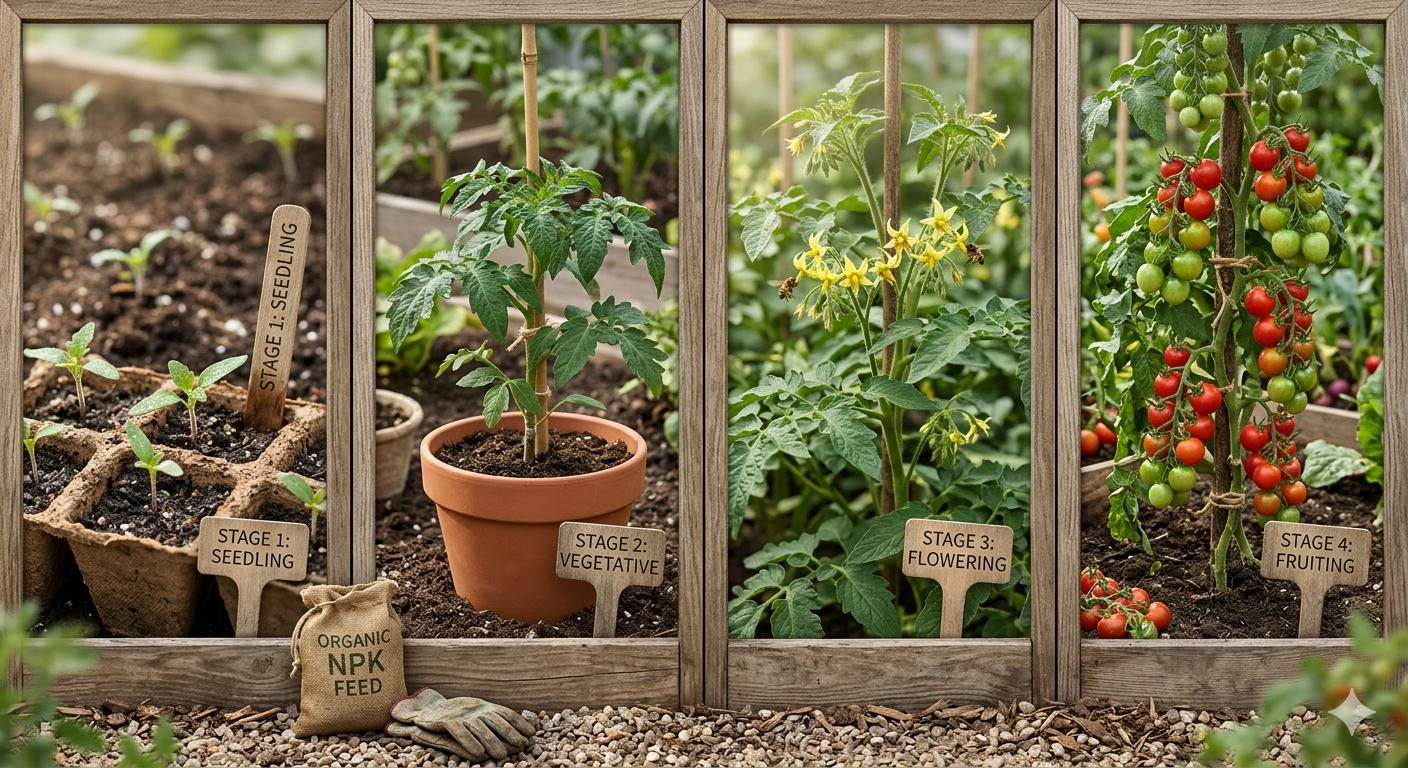
One thing that trips up beginners consistently is using the same NPK fertilizer ratio throughout the entire plant lifecycle. Plants don't have the same nutritional needs at every stage. They change, sometimes quite dramatically, and your feeding program should change with them.
Here's a rough breakdown of what most crops need at each stage.
Germination and seedling stage. Very little fertilizer needed at all. Seeds carry their own energy reserves for germination, and tiny seedlings have tiny roots that can't handle high nutrient concentrations. If you're starting seeds in a good potting mix or hydroponic medium, hold off on fertilizing for the first week or two. When you do start, use a very dilute solution, maybe 25-50% of the normal dose, with a higher phosphorus ratio to support early root development. Something like 10-30-10 or a similar high-P NPK fertilizer profile works well here.
Vegetative stage. This is when plants are building structure, producing leaves and stems, and establishing the framework that will support flowers and fruit later. Nitrogen drives this phase. Higher N ratios, something like 3-1-2 or 20-10-20 on a product label, match what the plant is doing. In soil, this is when regular nitrogen applications through liquid fertilizer or a moderate granular soil fertilizer matter most. In hydroponics, keep EC in the mid range and nitrogen as the dominant nutrient.
Pre-flowering and transition. When a plant shifts from vegetative to reproductive mode, its nutrient needs shift noticeably. Nitrogen demand decreases. Phosphorus demand increases because phosphorus is intimately involved in flower initiation and pollen development. Many growers switch to a "bloom" formula here, which is typically lower N and higher P and K. In hydroponic fertilizer terms, you might shift from a 3-1-2 ratio toward something like 1-3-2.
Flowering and fruiting. Phosphorus and potassium are the stars of this stage. Potassium in particular drives fruit development, sugar accumulation, and overall quality. Low K at this stage shows up as poor fruit set, bland flavour, and sometimes blossom end rot in tomatoes and peppers (which is also partly a calcium issue). A high K liquid fertilizer or a potassium-rich NPK fertilizer blend makes sense during fruiting. Many experienced growers also add potassium sulfate (SOP) as a supplement during this stage.
Late stage and ripening. Some growers reduce overall nutrient levels in the final weeks before harvest, particularly nitrogen, to encourage the plant to use up stored reserves and improve flavour and ripening. In hydroponics this means reducing EC gradually. In soil it means backing off nitrogen liquid fertilizer applications. This isn't universally practiced but there's reasonable evidence it improves flavour in fruit crops.
Understanding this progression is genuinely more valuable than knowing which specific product to buy. Because once you understand what the plant needs and when, choosing the right NPK fertilizer for each stage becomes logical rather than confusing.
Secondary nutrients and micronutrients, the ones nobody talks about
Everyone learns about N, P, and K. Far fewer beginners learn about calcium, magnesium, sulfur, iron, and the rest until something goes wrong.
Secondary nutrients, calcium, magnesium, and sulfur, are needed in meaningful quantities, smaller than NPK but larger than true micronutrients. Most soil fertilizer programs and most complete hydroponic fertilizer products cover these. But deficiencies happen.
Calcium deficiency shows up as distorted new growth, tip burn on leaves, and blossom end rot in fruiting vegetables. In hydroponics, calcium is a critical component of the nutrient solution and needs to be in every complete hydroponic fertilizer formula. In soil, calcium deficiency is often linked to pH being too low (acidic soils), which limits calcium availability even when it's present.
Magnesium deficiency causes interveinal chlorosis, yellowing between the leaf veins while veins stay green. Classic symptom. Epsom salt (magnesium sulfate) is the go-to quick fix for both soil and hydroponic use. A teaspoon per litre as a foliar spray works fast for acute deficiency.
Sulfur deficiency looks similar to nitrogen deficiency at first but tends to start with newer growth rather than older leaves. Most complete fertilizer programs cover sulfur adequately, so pure sulfur deficiency is less common than the big three.
For micronutrients, iron is the one that causes the most problems. Iron deficiency shows as yellowing of new leaves with green veins, similar to magnesium but on different leaves. The tricky thing about iron is that it's often present in the soil but unavailable because pH is too high. Soil pH above 7 locks iron up. The solution is often pH adjustment rather than adding more iron. In hydroponics, iron chelates (EDTA or DTPA forms) are the standard way to keep iron available across the pH range.
Manganese, zinc, boron, copper, and molybdenum are needed in tiny quantities but are absolutely essential. Complete hydroponic fertilizer formulas include them. Organic soil systems typically get enough from compost, worm castings, and natural soil reserves. Problems tend to appear in highly leached soils or very pH-extreme conditions.
Building a simple feeding schedule
The most practical thing you can do after understanding all of this is build a simple, consistent feeding schedule. Not complicated. Not fifteen different products. Something you'll actually stick to.
For soil growing, a basic schedule might look like:
Pre-planting, work a balanced granular NPK fertilizer and compost into the soil. Something like a 5-5-5 or 10-10-10 granular provides baseline nutrition. Compost adds biology.
Every two weeks during vegetative growth, apply a liquid fertilizer with a higher nitrogen ratio, diluted as per instructions. Water in well.
When flowering begins, switch to a liquid fertilizer with higher P and K. Continue every two weeks.
Every month, check soil moisture and apply a dilute liquid fertilizer with calcium and magnesium if you're running an intensive system or seeing signs of deficiency.
That's it. You could add more products and more complexity but this basic structure keeps most crops healthy.
For hydroponics, the schedule is more frequent because the solution is the only nutrition source:
Mix a fresh reservoir with complete hydroponic fertilizer, check EC and pH, adjust both. Do this every 7-10 days for recirculating systems, or as needed for drain-to-waste systems.
Top up with fresh water between reservoir changes to compensate for evaporation and plant uptake. Check and correct pH every 2-3 days because pH drifts in active hydroponic systems.
Adjust EC upward gradually as plants grow and their nutritional needs increase.
Flush the growing medium with plain pH-adjusted water every 2-3 weeks to prevent salt accumulation.
Simple, consistent, and effective.
Final thoughts
Fertilizer mixing isn't complicated once you get the logic down. Know your system, know your plant's stage, pick the right product form, measure properly, and check your work with the right tools.
The biggest shift in thinking for most beginners is realising that different growing systems actually need different fertilizer strategies. What works beautifully in an outdoor soil bed doesn't translate to a DWC hydroponic tank. And that's okay. They're different tools for different jobs.
Start simple. One product, one system, get comfortable with it. Once you understand how that product behaves and how your plants respond, you can start experimenting with blends, supplements, and more advanced techniques.
Growing is genuinely easier when you understand the nutrition side. Plants are pretty forgiving once they have what they need. And the satisfaction of watching something grow well because you got the feeding right, that part never gets old.
When in doubt about how much to mix, just use the calculator.